




Players Don’t Read Interfaces Sequentially

One of the biggest misconceptions in UI design is that users process information in an organized order.
In slot games, this almost never happens.
Players do not carefully inspect every element on the screen. Instead, their attention jumps between focal points based on motion, contrast, size, and expectation.
This creates a visual hierarchy whether the designer intended one or not.
The strongest slot interfaces are not necessarily the most detailed or visually impressive. They are the ones that guide the player’s eye naturally without creating friction.
The Spin Button Controls Attention

In most slot games, the spin button becomes the primary anchor point of the entire interface.
Players return to it constantly.
This means its role goes beyond functionality. It acts as a psychological center of interaction, anticipation, and reward. The brain learns where it is almost immediately, and from that moment, many other interface decisions are interpreted relative to it.
When the spin button lacks contrast, competes with nearby UI elements, or feels visually weak, the entire interface starts to feel less stable.
Interestingly, some of the strongest-performing slot interfaces are extremely conservative around the spin area. They avoid unnecessary visual noise and preserve clarity around the main interaction point.
Motion Redirects the Eye Instantly

Human attention reacts to movement faster than almost anything else on screen.
This is why animation has such a strong impact on slot UX.
But there is an important distinction between animation that guides attention and animation that overwhelms it.
When too many elements move simultaneously, the interface loses hierarchy. The player no longer knows where to focus, and the experience begins to feel visually exhausting instead of exciting.
Strong slot interfaces use motion strategically. Animation highlights important moments:
- reel activity
- win feedback
- bonus triggers
- interaction states
Everything else stays relatively controlled.
This creates rhythm instead of chaos.
Players Scan Before They Understand
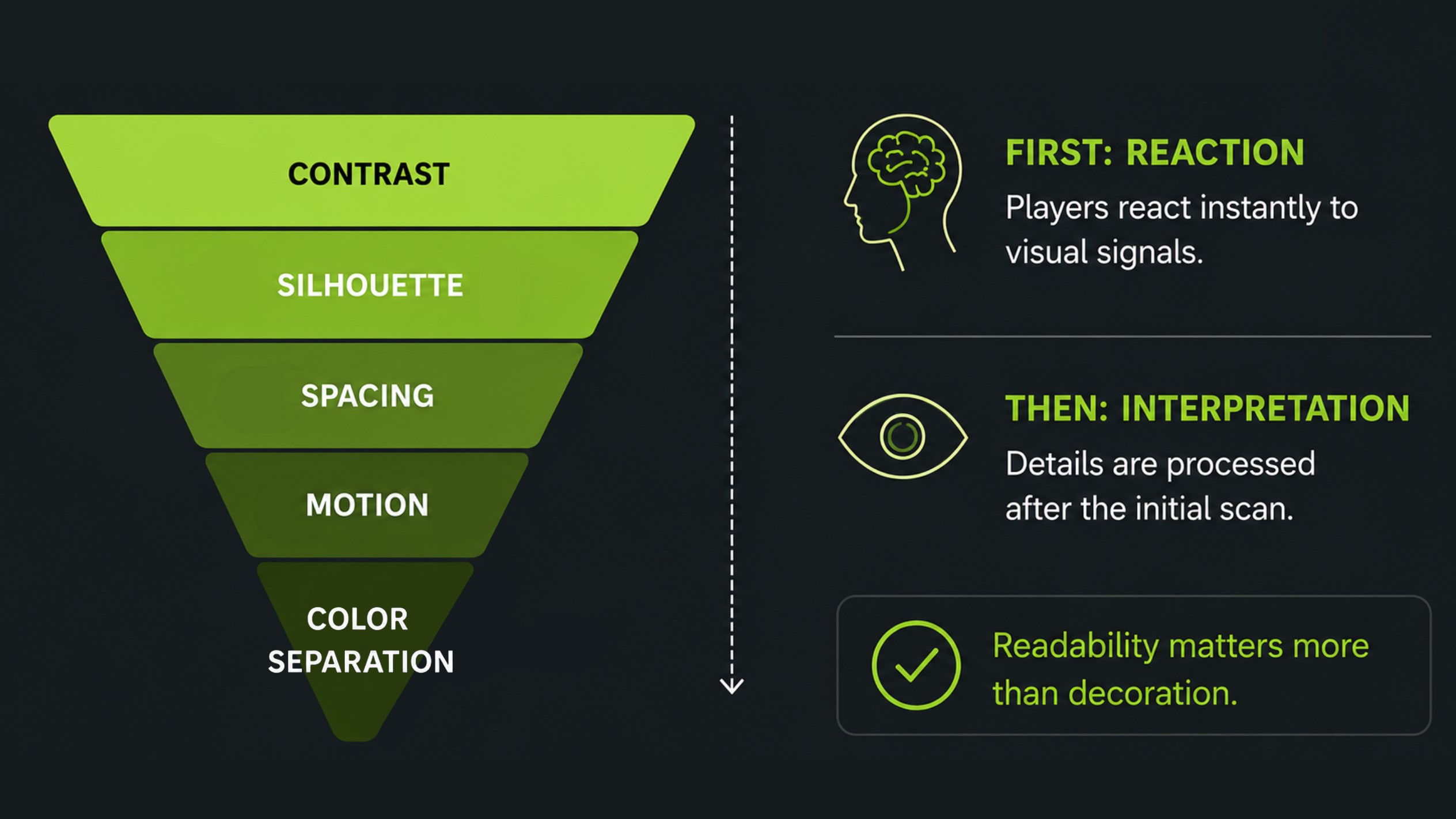
Most interface decisions happen before conscious interpretation.
Players first react to:
- contrast
- silhouette
- spacing
- motion
- color separation
Only after that do they begin processing details.
This is why readability matters more than decoration.
A highly detailed interface may look impressive in a presentation, but if players cannot quickly distinguish important information during gameplay, the experience becomes slower and more tiring.
This becomes even more important on mobile devices, where interfaces are compressed and visual competition increases.
Information Hierarchy Shapes Trust
Players constantly ask themselves small subconscious questions while playing:
“What happened?”
“What did I win?”
“What should I look at next?”
Good UI answers these questions instantly.
Poor hierarchy delays those answers.
When information feels difficult to locate, players experience uncertainty. Even small moments of hesitation can reduce the sense of smoothness and control.
This is why strong slot UI often feels “easy” to use even when players cannot explain why.
The interface reduces cognitive effort.
The Human Eye Searches for Patterns
Players adapt to slot interfaces quickly. Once they understand how the visual system behaves, they begin predicting interactions automatically.
This is why consistency matters so much.
If button states behave unpredictably, if animation intensity changes randomly, or if UI elements shift position unnecessarily, the player has to spend extra mental effort reprocessing the interface.
That effort creates friction.
Consistent systems reduce the amount of active thinking required during gameplay, which helps the experience feel smoother and faster.
Why Overdesigned Interfaces Often Perform Worse
A common production mistake is assuming that more detail creates a better experience.
In practice, overloaded interfaces often reduce usability.
Too many highlights compete for attention. Decorative elements interrupt hierarchy. Excessive effects weaken focus instead of strengthening it.
The player’s eye no longer knows where to settle.
Strong slot UI is usually more restrained than people expect. It prioritizes clarity first and decoration second.
Ironically, this often makes the game feel more premium.
Mobile Changed the Way Interfaces Are Read
Mobile devices significantly changed slot interface behavior.
On desktop, players have more visual space and more time to process details. On mobile, interfaces are compressed, sessions are faster, and attention shifts more aggressively.
This means mobile-friendly UI relies heavily on:
- larger focal points
- stronger contrast
- simplified hierarchy
- cleaner spacing
Elements that work well on desktop can become difficult to read when reduced to mobile scale.
Designing for mobile is no longer optional. It is part of core UX planning.
Emotion Affects Visual Attention
Players do not read interfaces neutrally.
Emotional states influence where attention goes.
During anticipation, players focus on reels and possible outcomes. During rewards, attention shifts toward win feedback and animation. During confusion, players search for orientation and clarity.
Strong interfaces support these emotional transitions instead of fighting them.
This is why slot UI is not just informational. It is behavioral.
The Best Interfaces Feel Invisible
One of the most interesting things about great slot UI is that players rarely notice it consciously.
When an interface works well, attention flows naturally through the experience. Players understand what is happening without effort.
Poor interfaces become noticeable because they interrupt that flow.
In other words, successful slot UI often feels invisible precisely because it removes friction so effectively.
Why This Matters for Studios
As competition in iGaming continues to increase, gameplay clarity becomes more important.
Players move quickly between games. If an interface feels confusing, visually exhausting, or difficult to process, they often leave before deeper engagement begins.
This means UI is no longer just a support layer for art.
It directly affects:
- retention
- session quality
- emotional pacing
- perceived polish
Understanding how players actually read interfaces allows studios to design games that feel smoother, clearer, and more rewarding from the very first spin.
Conclusion
Players do not read slot game interfaces the way designers expect.
They scan rapidly, follow motion instinctively, and rely heavily on visual hierarchy to understand the experience in real time.
The strongest slot interfaces succeed not because they contain more information, but because they guide attention more effectively.
In modern iGaming, good UI is not just about aesthetics.
It is about understanding human behavior.


.svg)


