




Write the Decision the Prototype Must Support
Choose one primary question: Is the mechanic understandable? Does the mobile layout work? Can the intended animation run within budget? Is the visual direction strong enough for stakeholder approval?
A prototype that tries to answer everything becomes a partial production build. Define success criteria and a review date before creating assets.
If external distribution is a goal, include the questions raised in How Casino Aggregators Evaluate New Slot Games: differentiation, clarity, technical readiness and commercial packaging.
Map One Complete Round
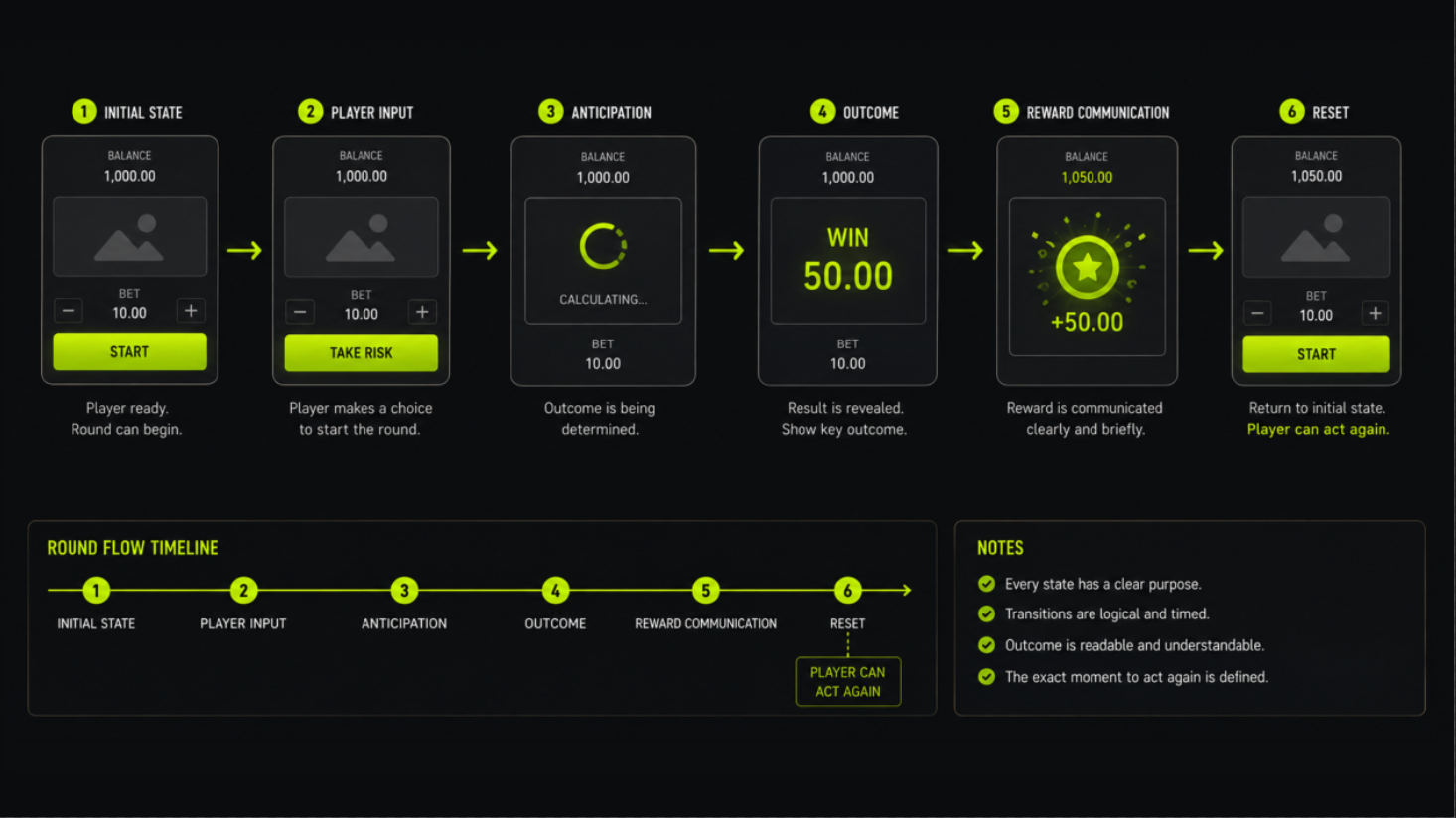
Storyboard the sequence from initial state through player input, anticipation, outcome, reward communication and reset. Add error or interruption only if it is central to the risk being tested.
Use simple boxes and values first. This reveals missing states and prevents the art team from solving layout problems inside finished illustration.
Label the exact moment when the player can act again. Many prototypes show a beautiful outcome but fail to define the transition into the next round.
Choose the Right Fidelity for Each Layer
Use high fidelity for the layer under evaluation and low fidelity elsewhere. If the question is art direction, render the hero state and keep secondary panels simple. If the question is interaction, prioritize functional states over final texture.
Create one representative asset per category rather than a complete set. One premium symbol, one character reaction or one finalized tile state can establish the quality bar.
Document what is intentionally temporary. Stakeholders often mistake polished areas for finished scope and unpolished areas for forgotten work.
Prototype the Motion Hierarchy
Block timing with basic transforms before producing complex animation. Establish input response, anticipation length, result reveal, celebration tier and return to idle.
Test the sequence at normal play speed and in repeated rounds. An animation that feels impressive once may feel slow on the tenth repetition.
Use Slot Game Animation Pipeline Explained to decide which motion should be code-driven, frame-based or rigged before production begins.
Put the Prototype on a Real Device
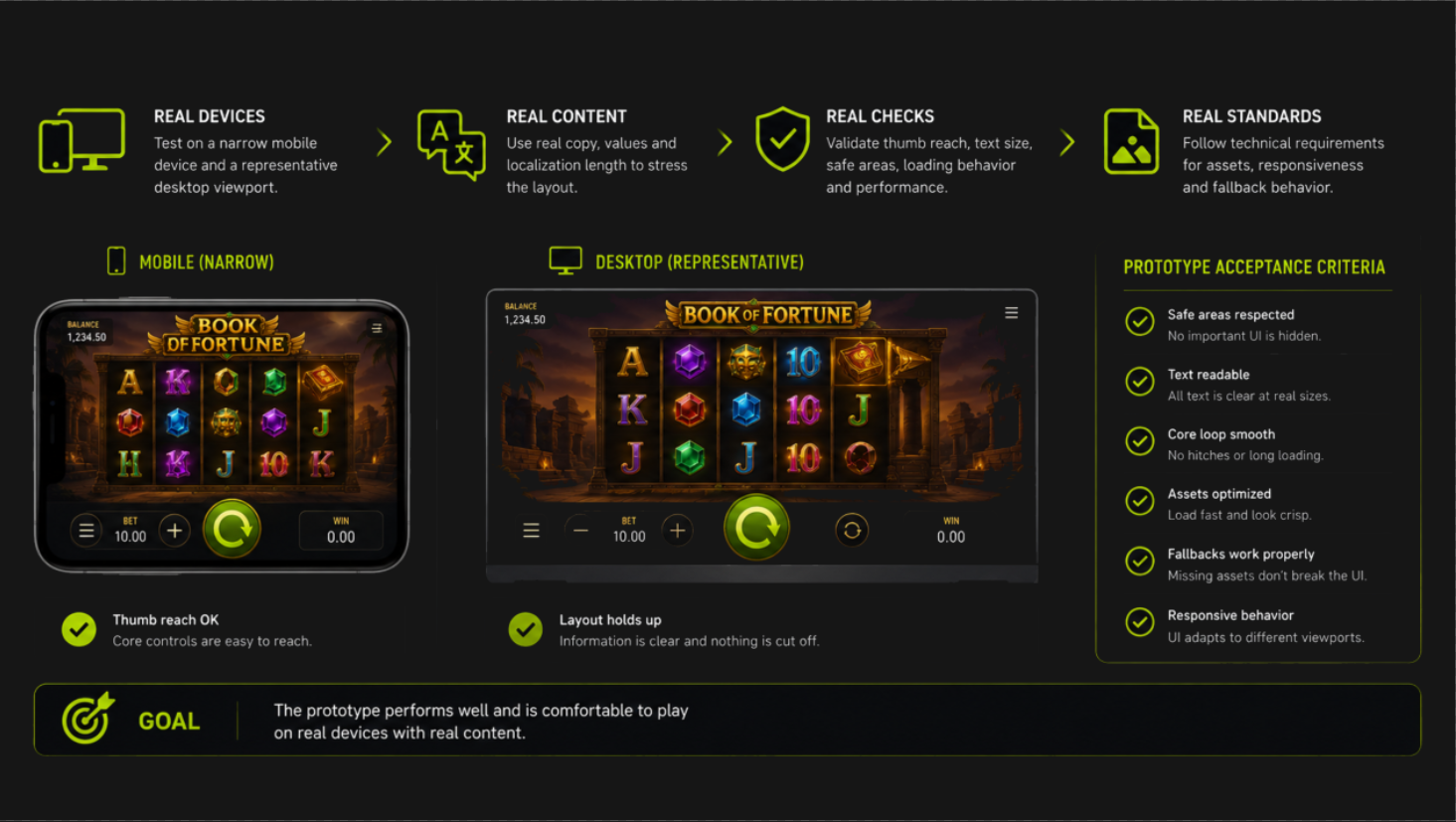
A desktop preview cannot prove thumb reach, text size, safe areas or loading behavior. Test the core loop on at least one narrow mobile device and one representative desktop viewport.
Use realistic copy, values and localization length. Placeholder labels produce false confidence because they rarely stress the layout.
Technical checks from Technical Requirements for Slot Game Graphics can be converted into prototype acceptance criteria for texture size, responsiveness and fallback behavior.
Review With Tasks, Not Opinions
Ask reviewers to perform the core action, change a parameter, explain the result and start another round. Record where they hesitate or misread a state.
Collect feedback in categories: comprehension, hierarchy, timing, visual direction, technical risk and missing content. This prevents a color preference from being treated as equal to a broken interaction.
Resolve the highest-risk finding first and run the same tasks again. A prototype earns its value through iteration, not presentation alone.
Convert the Prototype Into a Production Plan
After approval, inventory the remaining assets, variants, animation states, responsive layouts and promotional outputs. Assign owners and define review gates.
Capture decisions about palette, lighting, typography, shape language, export format and technical budgets in a concise style guide and asset brief.
The Slot Game Graphics Technical Brief can turn the validated prototype into a production-ready handoff without losing the reasoning behind it.
Conclusion
A good visual prototype is not a small finished game. It is a decision tool that renders the riskiest parts of the experience and leaves the rest deliberately simple. By testing one complete round, realistic layouts and representative motion, teams can approve direction, expose production risk and estimate the remaining work with far greater confidence.


.svg)


