





The Core Difference Is Where Meaning Lives
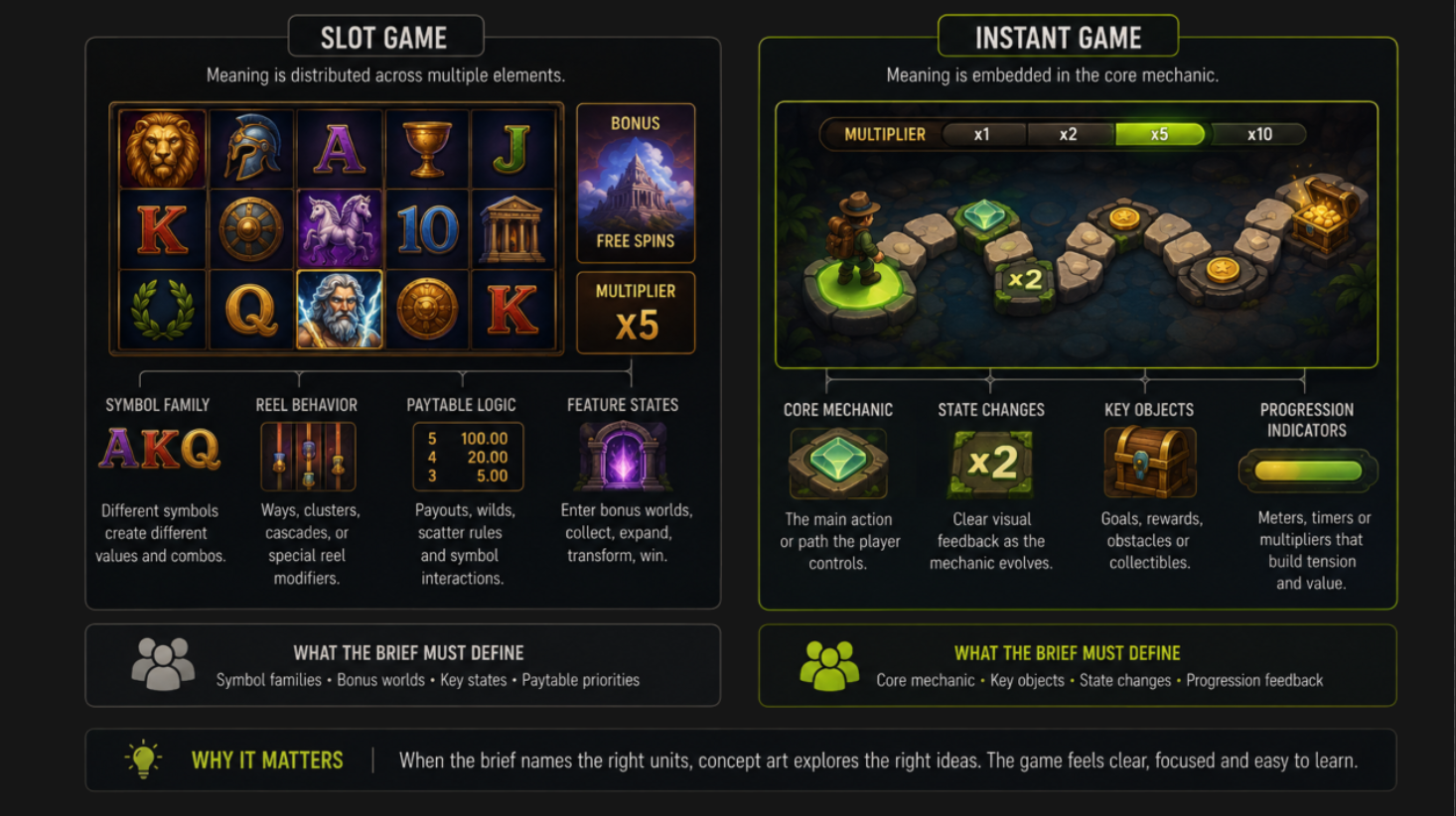
In a slot, meaning is distributed across a symbol family, reel behavior, paytable logic and feature states. In an instant game, meaning is often embedded in a board, path, meter, object or timed multiplier.
That difference changes concept art. Slot teams explore symbol families and bonus worlds; instant-game teams should explore the mechanic’s visual metaphor and how it changes state.
Both formats need a clear hierarchy, but the hierarchy is built from different units. The brief should name those units before the artist begins final rendering.
Compare the Asset Inventory
A typical slot requires low and high symbols, wild and scatter states, frames, reels, background layers, paytable content, feature UI and several win presentations. Variants multiply quickly when symbols need static, animated and special versions.
An instant game may use fewer unique illustrations but require more interaction states: selectable, active, revealed, locked, failed, collected and reset. A small grid can generate a large state matrix.
Use the Slot Game Graphics Technical Brief as a base, then replace reel-specific fields with mechanic-specific state definitions.
Animation Has a Different Rhythm
Slot animation is frequently layered around anticipation, reel stops, line wins, symbol loops and feature transitions. It needs a clear hierarchy so simultaneous events do not overwhelm the reels.
Instant games often build one continuous motion or reveal sequence. The animation must preserve control feedback and make the result readable at the exact moment it resolves.
For both formats, plan animation states before production. Slot Game Animation Pipeline Explained outlines the handoff logic, naming and review stages that prevent isolated clips from becoming an inconsistent system.
UI Scope Shifts From Information to Interaction
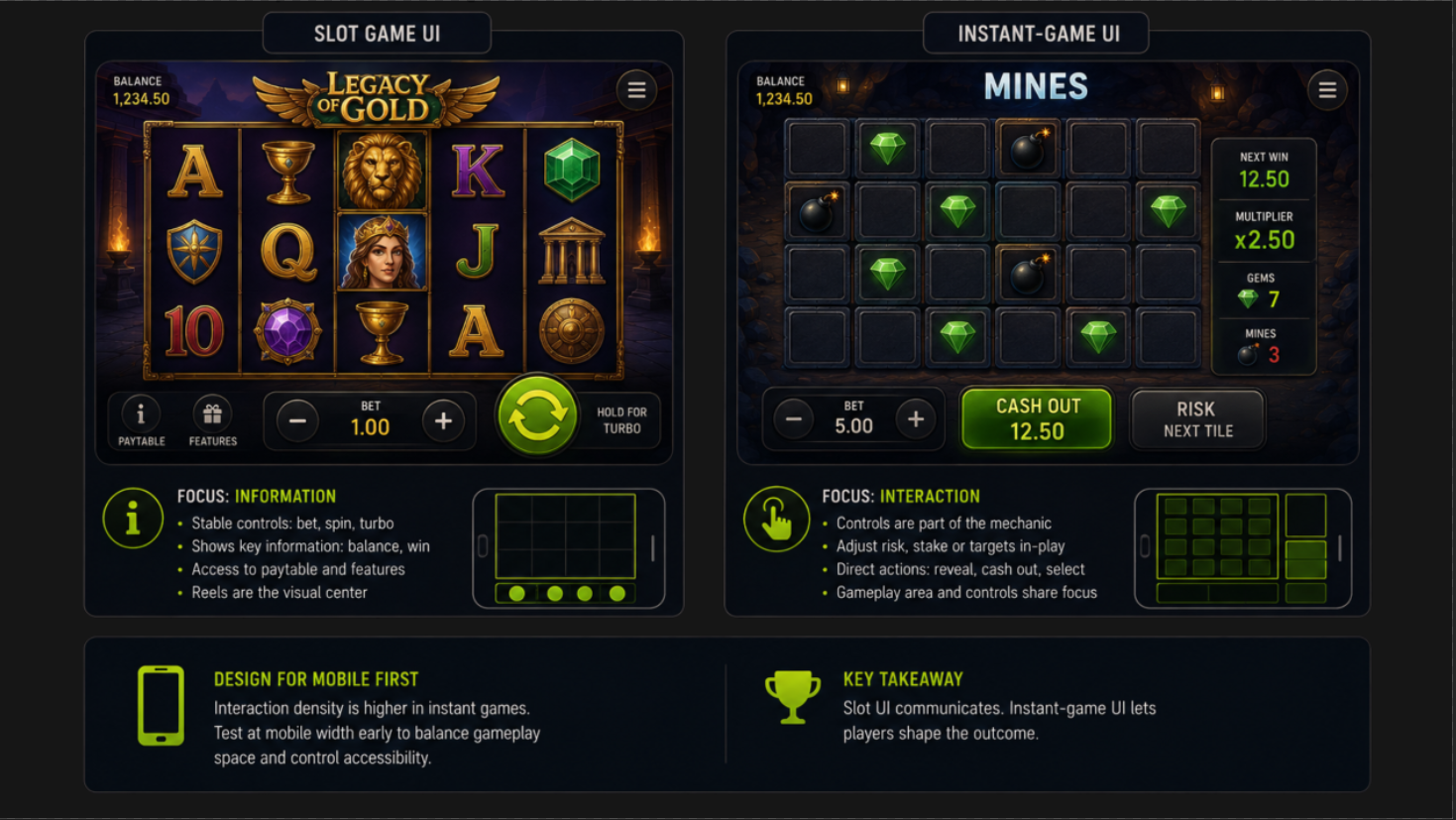
Slot UI needs stable stake controls, spin behavior, balance and win values, plus access to paytable and feature information. The reel area remains the visual center.
Instant-game UI may expose more mechanic parameters directly: risk, rows, targets, selections or cash-out. Those controls are part of the game, not a frame around it.
Prototype interaction density at mobile width. A desktop composition can hide the conflict between gameplay space and parameter controls until late in production.
Technical Budgets Should Follow Reuse Patterns
Slots can gain efficiency through shared symbol rigs, reusable effects and controlled background layers. Instant games can gain efficiency through component states, procedural motion and code-driven geometry.
Do not force a skeletal-animation pipeline onto an object that is easier to move in code, and do not rebuild a complex character sequence from dozens of frame images if a rig is the better fit.
The mobile and HTML5 considerations in Technical Requirements for Slot Game Graphics apply to both formats: memory, loading, atlases and fallbacks must be decided before final export.
Reviews Need Different Milestones
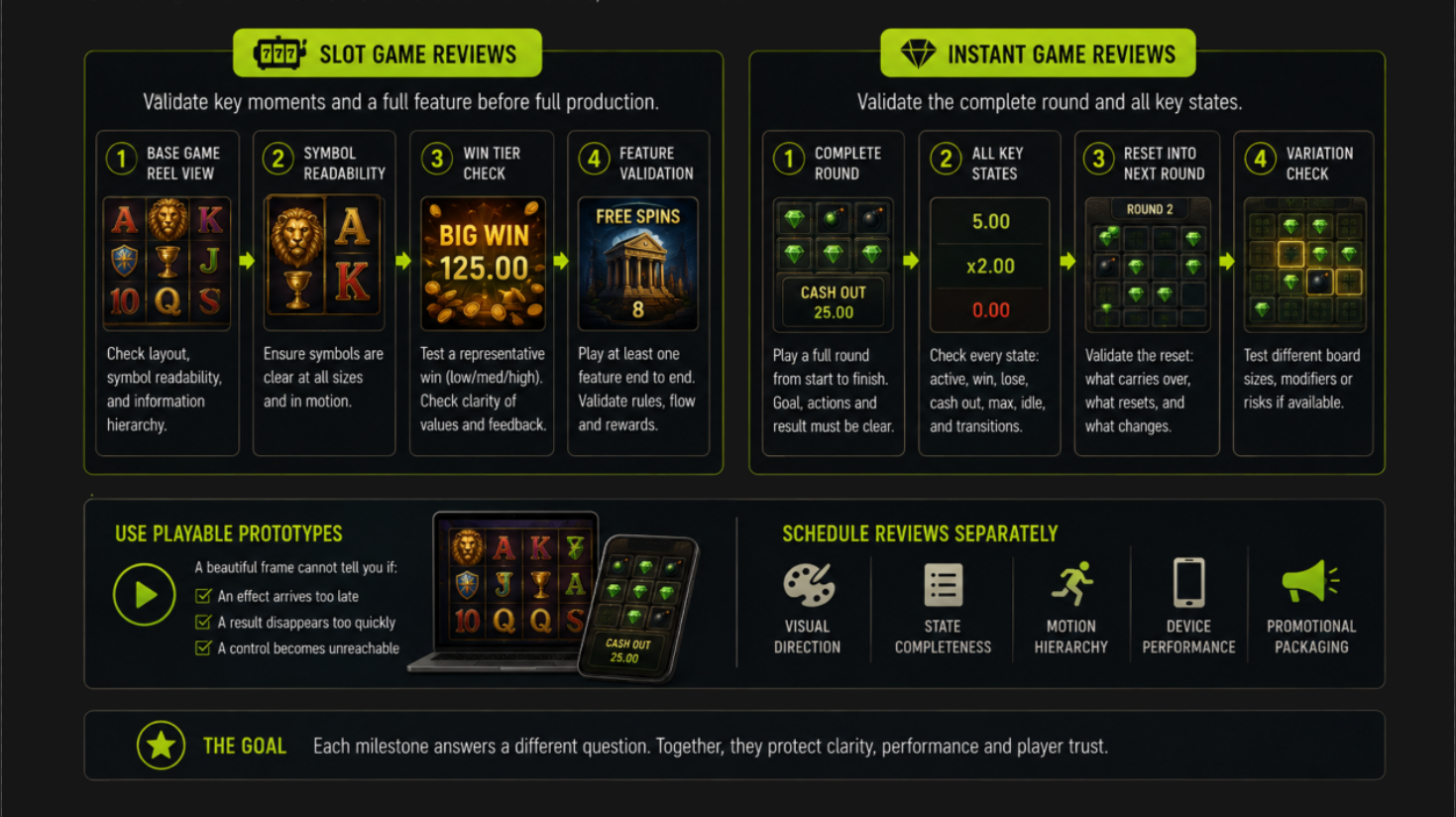
A slot should validate the base-game reel view, symbol readability, representative win tier and at least one feature before full asset production. An instant game should validate the complete round, every key state and the reset into the next round.
Use playable prototypes during art review. A beautiful frame cannot reveal whether an effect arrives too late, a result disappears too quickly or a control becomes unreachable.
Schedule separate reviews for visual direction, state completeness, motion hierarchy, device performance and promotional packaging.
Estimate Complexity From States, Not Screens
A one-screen instant game can be more complex than a multi-screen slot if every object has many conditional states. Conversely, a slot with a reusable symbol system can be efficient despite a large visible asset count.
Estimate by unique concepts, render variants, animation states, responsive layouts and revision risk. Add integration and QA time explicitly rather than hiding it inside illustration hours.
A scalable system, as described in How to Build a Scalable Slot Game Art System, makes both estimates more reliable because reuse is designed rather than assumed.
Conclusion
Slots and instant-win games share visual-quality goals but organize complexity differently. Slots need coherent symbol and feature systems; instant games need precise interaction states and result choreography. Scope the units that carry meaning, choose technology around reuse and review a playable loop before scaling production.


.svg)


