




Reward Is About Perception, Not Just Payout
One of the biggest misconceptions in slot production is assuming that players respond mainly to numerical value.
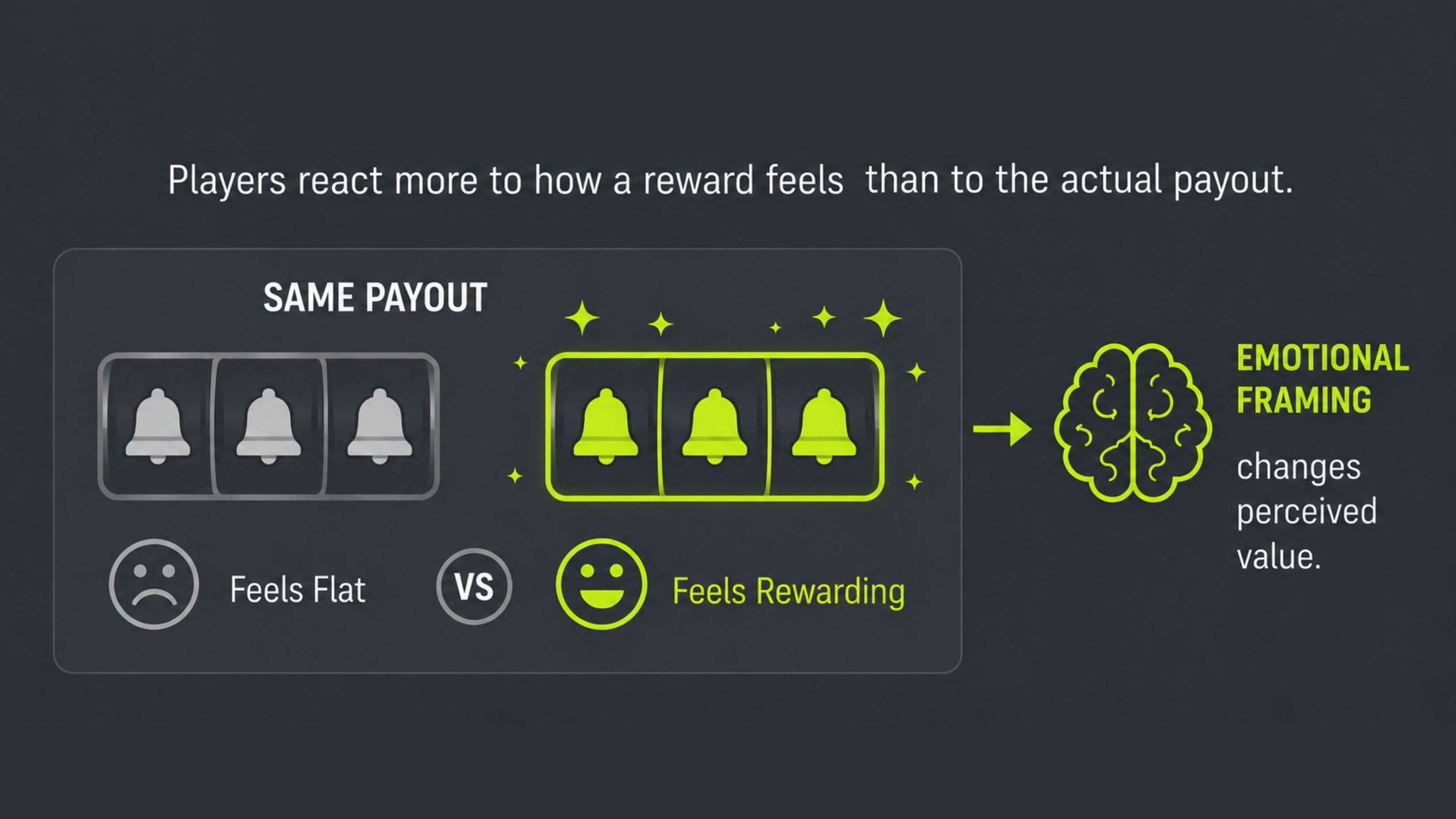
In practice, players react more strongly to how a reward feels than to the actual payout itself.
A medium-sized win can feel exciting when the game builds anticipation properly and delivers satisfying feedback. A larger payout can feel surprisingly flat if the presentation lacks pacing or emotional contrast.
The emotional framing around a reward changes the player’s perception of value.
This is why reward systems in slot games are deeply connected to visual and audio design.
Visual design influences far more than aesthetics. As we discussed in How Slot Game Art Impacts Player Retention and Revenue, the way players perceive rewards can directly affect engagement, session length, and long-term retention.
Anticipation Creates Emotional Investment

One reason some slot games feel more rewarding is because they create stronger anticipation before outcomes are revealed.
The emotional experience starts long before the win appears on screen.
Small delays before the final reel stops, subtle slowdown effects, lighting changes, sound buildup, and focused animation timing all increase player attention. The brain begins predicting a possible reward before it actually happens.
This anticipation creates emotional investment.
And when a reward finally appears, the emotional release feels stronger because tension existed beforehand.
Without anticipation, rewards often feel transactional instead of exciting.
Timing Changes Everything
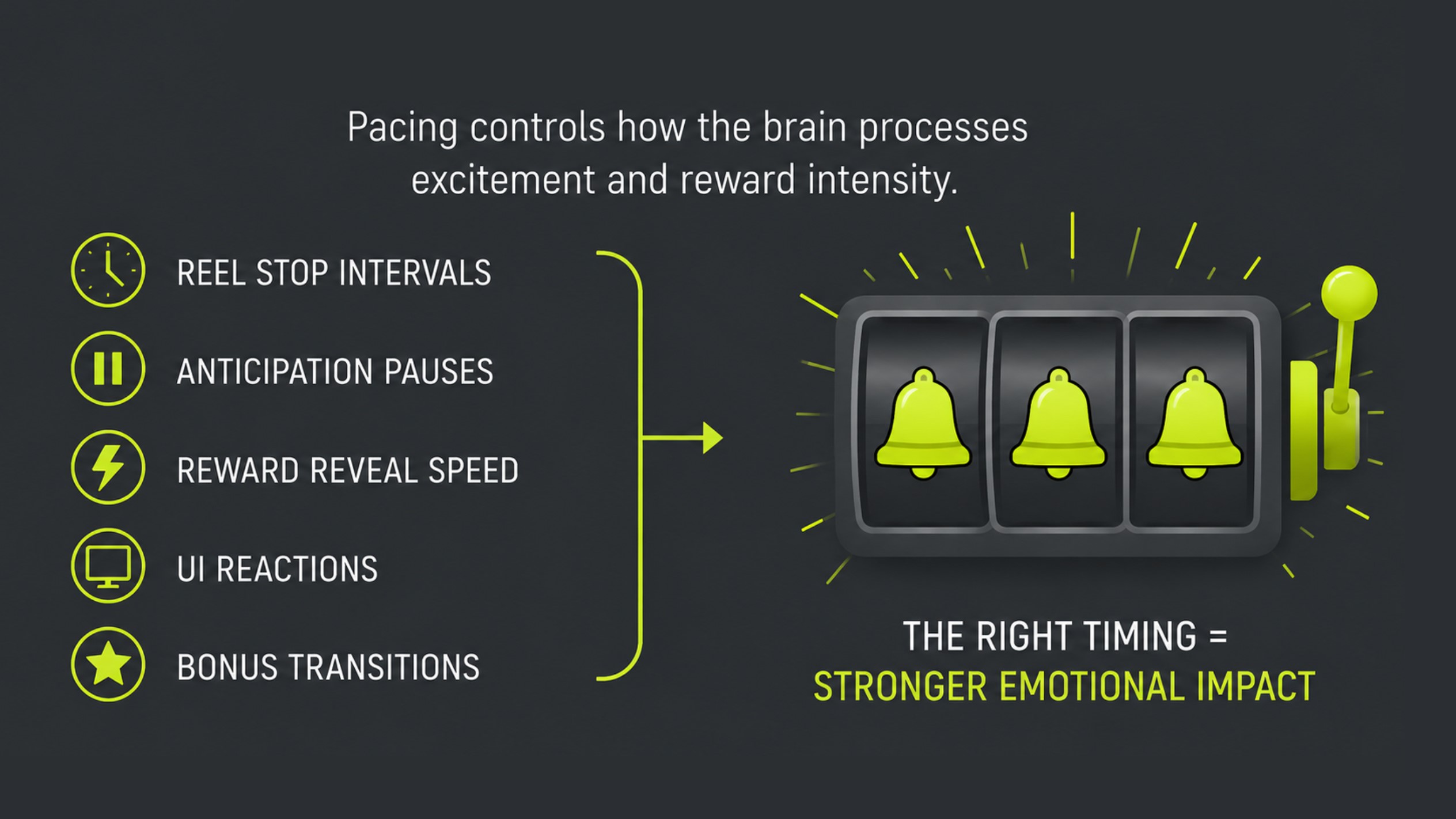
In many cases, timing matters more than visual complexity.
A simple animation delivered at the right moment can feel more satisfying than a technically impressive sequence with poor pacing.
Slot games constantly control emotional rhythm through timing:
- reel stop intervals
- anticipation pauses
- reward reveal speed
- UI reactions
- bonus transitions
These timing decisions influence how the brain processes excitement and reward intensity.
Games that feel rewarding usually understand pacing extremely well. They allow emotional tension to build before releasing it.
Games that move too quickly often reduce emotional impact because the player has no time to process anticipation.
Visual Hierarchy Directs Emotional Focus
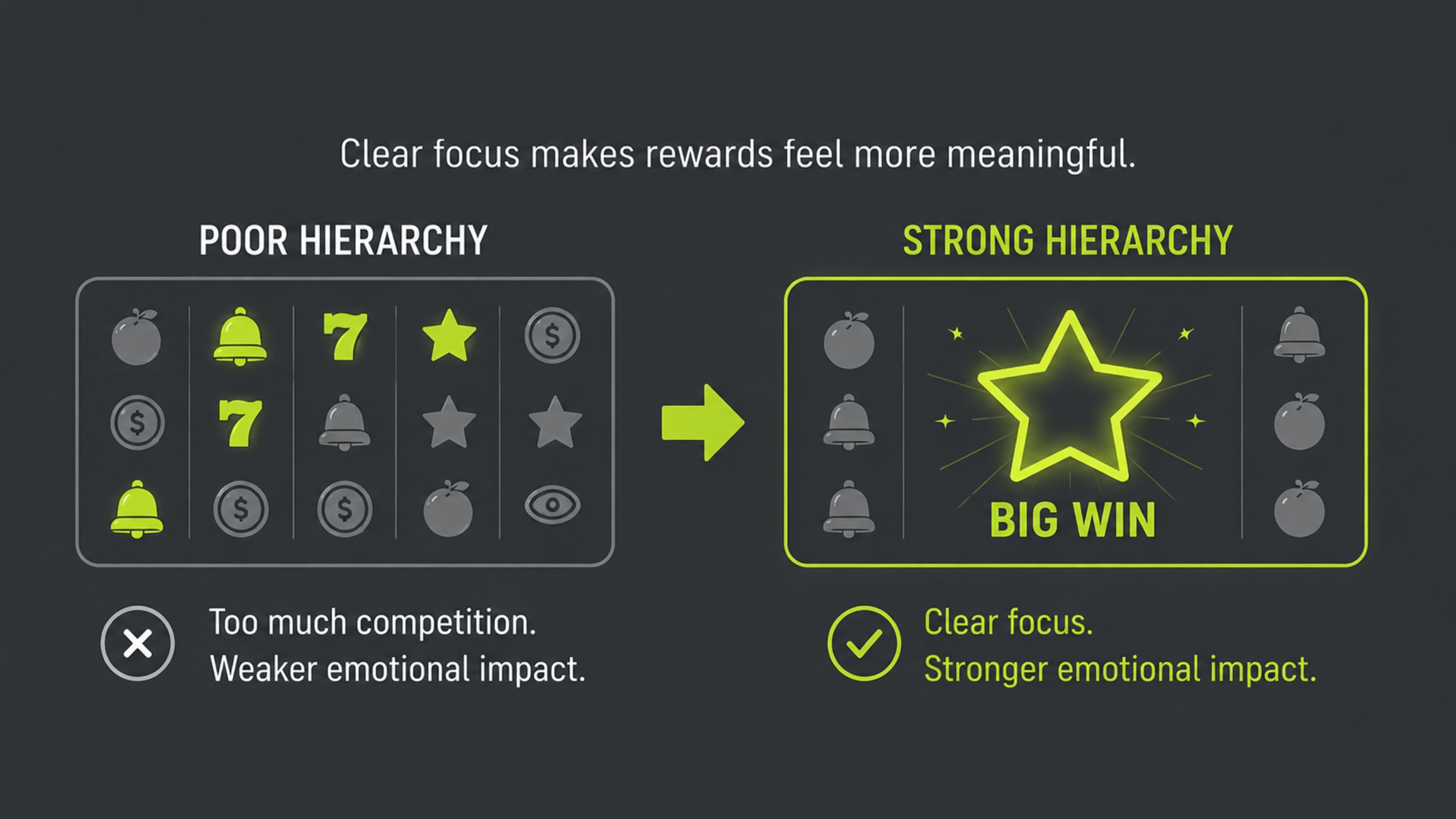
Players need to understand what matters emotionally in each moment.
Strong slot games use visual hierarchy to guide attention clearly during rewards.
When an important win happens, the interface usually simplifies automatically. Certain elements dim, motion becomes more focused, and visual emphasis shifts toward the reward itself.
This concentration of attention increases emotional impact.
Understanding where players look during gameplay is critical. In How Players Actually Read Slot Game Interfaces, we explore how visual hierarchy shapes attention and influences player behavior.
By contrast, games with overloaded interfaces often weaken reward perception because too many things compete for focus simultaneously.
If every element tries to feel exciting, nothing feels special.
Animation Intensity Shapes Perceived Value
Players subconsciously associate animation intensity with reward importance.
This is why small wins, medium wins, and large wins usually feel different even before players consciously process the payout amount.
The game communicates value through:
- scale
- motion intensity
- lighting
- camera effects
- particle behavior
- pacing
These visual signals help the player emotionally categorize the reward.
Consistent use of visual feedback is often the result of strong creative leadership.
Importantly, the strongest games do not keep intensity at maximum constantly. They create escalation.
If every win receives huge effects, emotional contrast disappears very quickly.
The most effective slot experiences save stronger feedback for moments that genuinely need to feel important.
Sound Synchronization Increases Reward Impact
Visual feedback becomes much more powerful when combined with synchronized audio.
Players react strongly to timing alignment between:
- reel stops
- symbol hits
- flashes
- UI reactions
- reward counters
Even subtle synchronization creates a sense of responsiveness and physicality.
The game begins to feel reactive rather than passive.
This is one reason why some slot games feel “alive” while others feel flat, even when the visual quality itself is strong.
The emotional system depends on synchronization between senses.
Near-Wins Keep Emotional Momentum Alive
One of the most interesting aspects of slot psychology is the near-win effect.
Even though the player technically loses, the game visually communicates proximity to success.
This often happens through:
- reel pacing
- symbol positioning
- anticipation timing
- delayed reveals
Emotionally, the brain does not process a near-win the same way as a normal loss. Instead, it creates continued engagement and sustained expectation.
This emotional momentum is one reason players remain invested across repeated spins.
Strong slot games understand how to balance tension and release carefully over time.
Clarity Makes Rewards Feel Better
A surprising number of slot games reduce reward impact simply because the interface becomes too visually noisy.
When effects overlap excessively, when UI hierarchy breaks down, or when animations compete simultaneously, players struggle to process what actually happened.
This weakens emotional response.
Good reward design depends heavily on clarity.
Interestingly, many premium slot experiences achieve their quality through simplicity rather than complexity. We explore this further in What Makes a Slot Game Look Premium?.
Players should immediately understand:
- that something valuable happened
- why it matters
- where attention should focus
The easier the reward is to process emotionally, the stronger it feels.
Emotional Rhythm Matters More Than Constant Excitement
One common production mistake is trying to make every moment feel intense.
In practice, constant intensity becomes exhausting very quickly.
Strong slot games create emotional rhythm instead:
- calm moments
- anticipation
- tension
- release
- recovery
This variation keeps the experience engaging over longer sessions.
Without quieter moments, larger rewards lose impact because there is no contrast between normal gameplay and important events.
Emotion depends on pacing.
Mobile Changed Reward Design
Mobile gameplay introduced new challenges for reward presentation.
Players process information faster on smaller screens, and sessions tend to be shorter and more fragmented. This means emotional feedback needs to become more concentrated and readable.
Subtle reward signals that work on desktop may become invisible on mobile.
Mobile-first design affects everything from animation timing to interface readability. For a deeper technical perspective, see Technical Requirements for Slot Game Graphics: HTML5 & Mobile.
Modern slot games increasingly rely on:
- stronger focal points
- simplified visual hierarchy
- clearer reward messaging
- cleaner animation pacing
The goal is not necessarily bigger effects, but faster emotional readability.
Why Reward Perception Matters for Retention
Players remember emotional experiences more than mathematical structures.
Most players cannot accurately describe a game’s RTP after a session. But they remember whether the experience felt exciting, smooth, rewarding, or emotionally satisfying.
This emotional memory strongly affects:
- retention
- return behavior
- session length
- perceived quality
In many ways, reward perception becomes part of the product identity itself.
Reward perception is closely tied to overall player experience. We recently explored this relationship in How Slot Games Create Emotional Feedback Through Visual Design.
The Best Slot Games Feel Rewarding Even Between Wins
Interestingly, the strongest slot experiences often maintain emotional engagement even during lower-intensity moments.
The game still feels responsive. The pacing still feels alive. Anticipation still exists.
This creates a sense of continuous emotional participation rather than waiting passively for occasional rewards.
The experience itself becomes satisfying, not just the payout moments.
This is one reason why some games maintain stronger engagement than others, even when their mechanics are similar. It also connects directly to the broader topic of How Slot Game Art Affects Casino Lobby Conversion, where first impressions shape player expectations before gameplay even begins.
Conclusion
Some slot games feel more rewarding than others because they understand emotional design more deeply.
Players do not respond only to payouts. They respond to anticipation, pacing, visual hierarchy, timing, animation intensity, sound synchronization, and emotional rhythm throughout the session.
The strongest slot experiences carefully shape how rewards are perceived, not just how they are calculated.
Because in modern iGaming, the emotional experience around the reward is often just as important as the reward itself.
For studios looking to create stronger emotional engagement through visuals, art direction, animation, and reward presentation, professional production planning can make a significant difference. You can also explore our collection of ready-made slot art packs designed specifically for modern HTML5 slot games.


.svg)


